











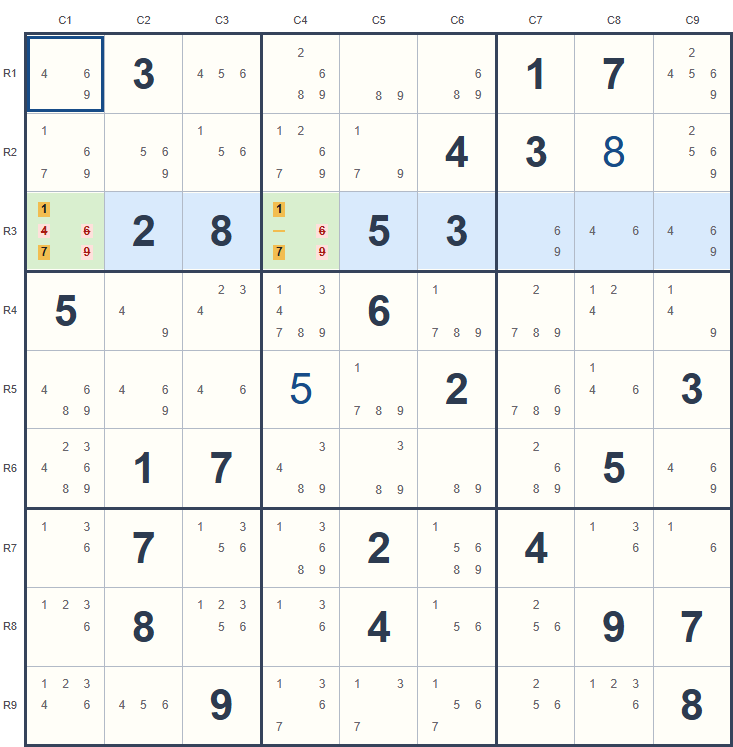
In row 3, the digits 1 and 7 can go only in the 2 highlighted cells. Those cells are reserved for these digits, so remove all other candidates from them.
What to look for
Choose two digits and find every cell where either is a candidate in one row, column or box. Together, their positions must cover exactly two cells.
Why it works
Both digits must appear in the house, and these are the only two cells available for them. Neither cell can contain any other digit.
Try it step by step
- Find two digits whose candidates are confined to the same two cells in one house.
- Leave candidates for those two digits in place.
- Remove every other candidate from the two cells.
Try it on a real puzzle
Start with the highlighted step, then keep solving. Use "Apply hint" to make the suggested change, or enter your own digits and candidate notes. Use "Undo" to reverse your last change.
| C1 | C2 | C3 | C4 | C5 | C6 | C7 | C8 | C9 | |
|---|---|---|---|---|---|---|---|---|---|
| R1 | |||||||||
| R2 | |||||||||
| R3 | |||||||||
| R4 | |||||||||
| R5 | |||||||||
| R6 | |||||||||
| R7 | |||||||||
| R8 | |||||||||
| R9 |
Use the arrow keys to move, 1-9 to enter a digit and Backspace or Delete to clear a cell. To add or remove a candidate, press C and then 1-9.
Source puzzle number: 110430 · Play this puzzle from the start
A simple example
If 1 and 2 are candidates only in R1C1 and R1C2 within row 1, keep {1, 2} in those cells and remove their other candidates.
A house is a row, column or 3 × 3 box. A line is a row or column. Two cells "see" each other when they share a house. R1C3 means row 1, column 3. Boxes are numbered 1-9 from left to right and top to bottom. Braces such as {1, 2} show a cell's candidates, not confirmed digits.