











The rules of Sudoku
Fill each empty cell with a digit from 1 to 9. Every row, column and 3 × 3 box must contain each digit exactly once.
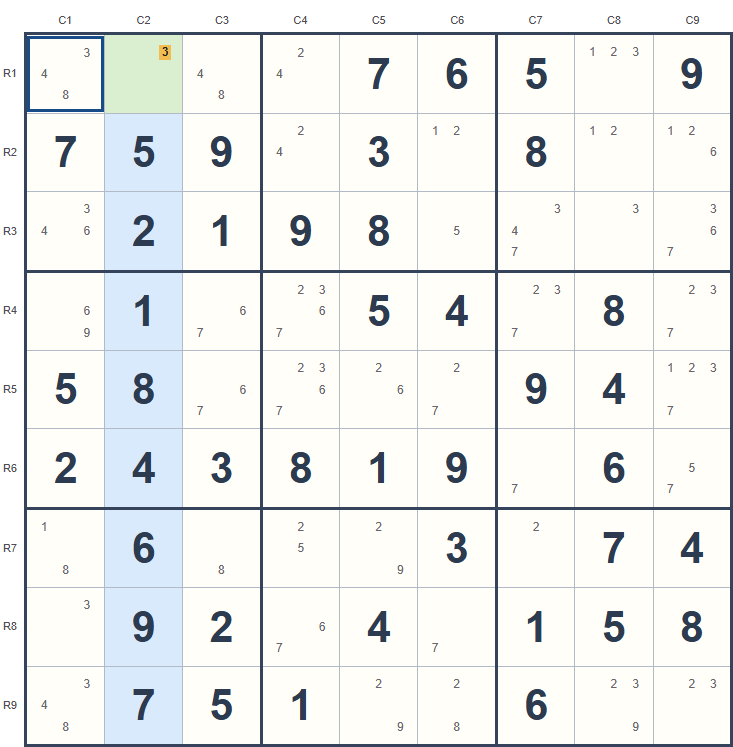
In column 2, eight cells are already filled. The missing digit is 3, so place it in R1C2.
Every row
Each horizontal row has nine cells and must contain all nine digits, with no repeats.
Every column
Each vertical column has nine cells and must contain all nine digits, with no repeats.
Every box
The thick lines divide the board into nine 3 × 3 boxes. Each box must contain all nine digits too.
Start with the givens
The digits already filled in are called givens or clues. They stay fixed throughout the puzzle. Use them to work out which digits are missing from each row, column and box.
Sudoku uses digits as symbols; you do not need to do any arithmetic. In a solved grid, each digit appears nine times, once in every row, column and box. Standard Sudoku has no special rules for diagonals.
Your first move
Look for a row, column or box with one empty cell. If its other digits are 1, 2, 3, 4, 5, 6, 7 and 9, the empty cell must be 8. This is called a full house.
After every placement, check its row, column and box again. One new digit can unlock several more cells.
Try it on a real puzzle
Start with the highlighted step, then keep solving. Use "Apply hint" to make the suggested change, or enter your own digits and candidate notes. Use "Undo" to reverse your last change.
| C1 | C2 | C3 | C4 | C5 | C6 | C7 | C8 | C9 | |
|---|---|---|---|---|---|---|---|---|---|
| R1 | |||||||||
| R2 | |||||||||
| R3 | |||||||||
| R4 | |||||||||
| R5 | |||||||||
| R6 | |||||||||
| R7 | |||||||||
| R8 | |||||||||
| R9 |
Use the arrow keys to move, 1-9 to enter a digit and Backspace or Delete to clear a cell. To add or remove a candidate, press C and then 1-9.
Source puzzle number: 148634 · Play this puzzle from the start
When the next digit is not obvious
Make candidate notes (often called pencil marks): the digits that could still go in each empty cell. Rule out any digit already placed in its row, column or box. These notes help you find a cell with only one possibility, or a digit with only one possible position in a row, column or box.
More advanced techniques often remove candidates before they reveal a digit you can place. Each correct removal brings you closer to the next step.