











Learn how to solve Sudoku, one step at a time
Learn the rules, get to know the board and discover advanced techniques to solve even expert Sudoku puzzles.
The basic rules
Learn how rows, columns and boxes work, and make your first move.
How to play online
Enter digits, make candidate notes and get help from the solver.
Is there a trick to solving Sudoku?
There is no magic trick, but there is a simple routine. Start with the easy cells: a row, column or box with only one empty cell, or a digit that fits in only one place. These are called singles. Check the row, column and box again after every digit you place.
When you get stuck, note the candidates for each empty cell. The techniques below help you rule them out until the next digit is certain. Singles alone solve every Easy and Medium puzzle on this site.
The technique library
Start with singles, then work your way through the more advanced techniques. The automatic solver that gives you hints uses the same techniques. It tries simpler deductions first and checks for new singles after each step.
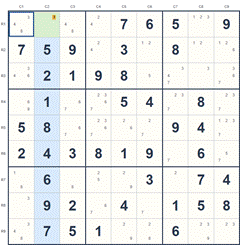
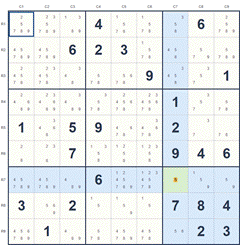
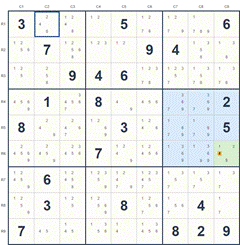
Singles
Find cells where the next digit is certain.
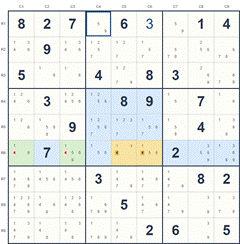
Locked candidates
Use the overlap between a box and a row or column.
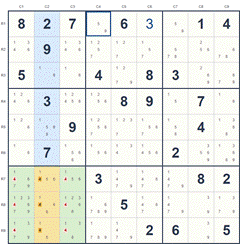
Naked subsets
Find cells that reserve a matching set of digits.
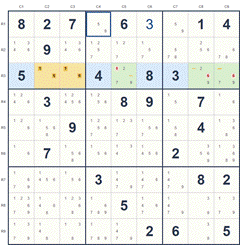
Naked pair
Two cells in the same house have the same two candidates. Remove those digits from the other cells in that house.
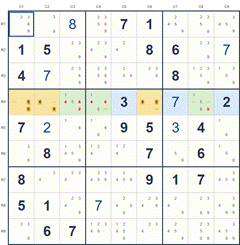
Naked triple
Three cells in the same house have just three different candidates between them. Those digits are reserved for the triple.
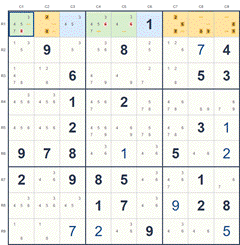
Naked quad
Four cells in the same house have just four different candidates between them. Those digits are reserved for the quad.
Hidden subsets
Find digits that can go in only a matching set of cells.
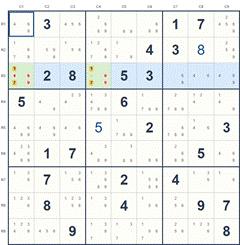
Hidden pair
Two digits can go in only the same two cells of a house. Remove the other candidates from those cells.
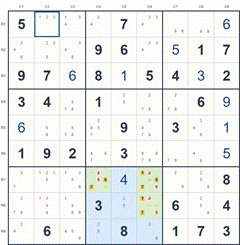
Hidden triple
Three digits can go in only three cells of a house. Remove the other candidates from those cells.
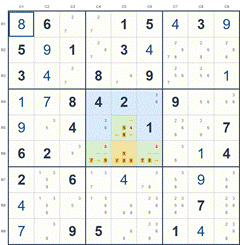
Hidden quad
Four digits can go in only four cells of a house. Remove the other candidates from those cells.
Fish patterns
Follow one digit across matching sets of rows and columns.
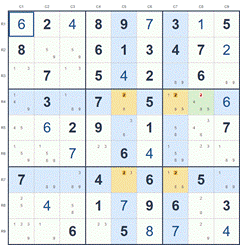
X-Wing
A digit's candidates in two rows line up in the same two columns. Remove that candidate from the rest of those columns.
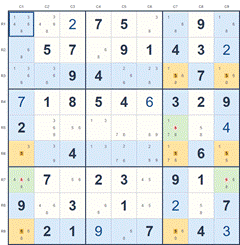
Swordfish
A digit's candidates in three rows are confined to three columns. Remove that candidate from the rest of those columns.
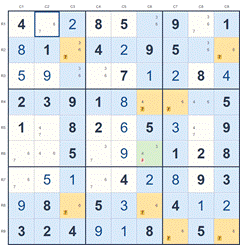
Jellyfish
A digit's candidates in four rows are confined to four columns. Remove that candidate from the rest of those columns.
Links and wings
Use connected candidate pairs to rule out other possibilities.
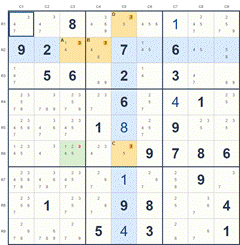
Two strong links
Connect two candidate pairs for the same digit. At least one of the two outer cells must contain that digit.
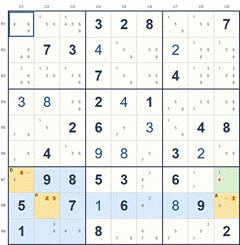
XY-Wing
A pivot with two candidates connects two pincers. At least one pincer must contain their shared digit.
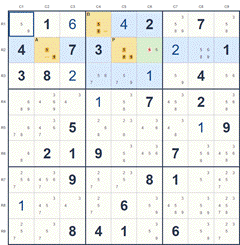
XYZ-Wing
Use a pivot with three candidates and two pincers to remove their shared digit from cells that see all three.