











How to play Killer Sudoku
Learn Killer Sudoku rules and use cage totals, digit combinations and the 45 rule to solve the puzzle.
Killer Sudoku combines the familiar Sudoku grid with arithmetic clues. The outlined groups are cages. Each cage has a small total, and its digits must add up to that number without repeating.
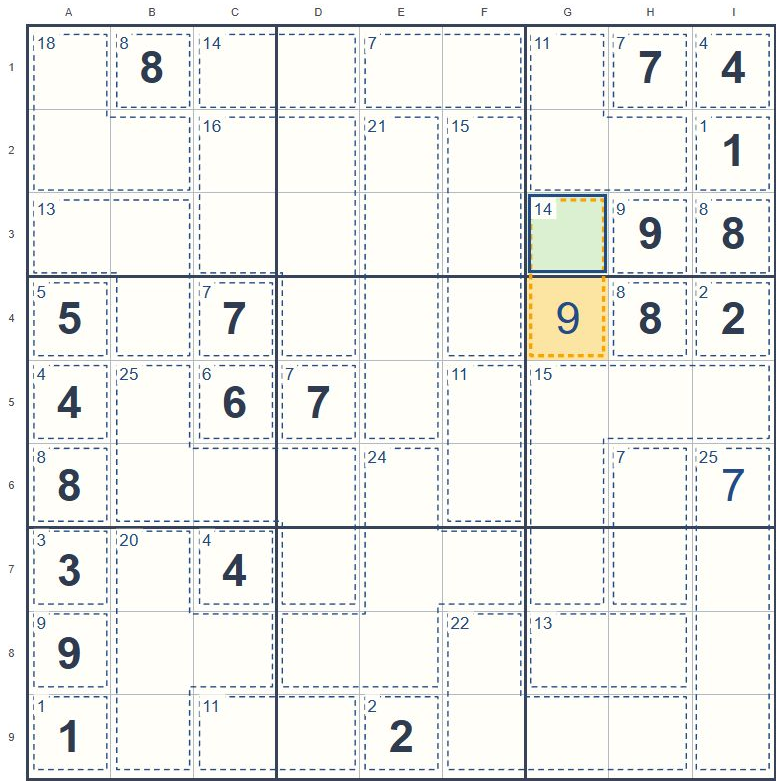
Subtract the filled digits in the cage at G3 and G4 from its total of 14. This leaves 5 for G3.
Normal Sudoku rules
Fill every cell with a digit from 1 to 9. Each row, column and 3 × 3 box must contain each digit exactly once.
Reach each cage total
The small number in a cage is the sum of all its cells. The outline tells you which cells belong to it, even when the cage crosses a box boundary.
No repeats inside a cage
A digit cannot appear twice in the same cage, even when the cells are in different rows, columns or boxes. A cage does not need to contain all nine digits.
Read the cage before placing a digit
A two-cell cage totaling 3 contains 1 and 2 in some order. A two-cell cage totaling 4 contains 1 and 3: 2 + 2 is not allowed. The sum gives a set of possibilities; rows, columns, boxes and other cages help decide their positions.
A one-cell cage already tells you its digit. On this site these cells are filled automatically and stay locked, just like ordinary givens. Other cages usually begin empty.
Use candidates and cage totals together
Turn on "Show candidates" to see possible digits. Automatic notes exclude digits already filled in the same row, column, box or cage. Sum-based eliminations are explained as hints, so an automatically displayed candidate can still be ruled out by a cage total.
For example, neither cell of a two-cell cage totaling 9 can contain 9: the other cell would have to be 0. If a hint marks 9 in just one cell, the other cell may already have lost that candidate through another rule.
Play Killer Sudoku online
- Choose one of the Killer Sudoku difficulties in the New puzzle selector. The board opens on the Killer Sudoku play page.
- Start with small cages and totals that have very few combinations. Keep using classic singles and other Sudoku techniques whenever they help.
- Select a cell and enter a digit with the keypad or the keys 1-9. Press C followed by a digit to add or remove a candidate note.
- Use "Hint" for a short prompt or "Solve one cell" for the full explanation. Some steps eliminate candidates before placing a digit. "Apply hint" makes that change, and "Undo" reverses it.
Try it on a real puzzle
Start with the highlighted step, then keep solving. Use "Apply hint" to make the suggested change, or enter your own digits and candidate notes. Use "Undo" to reverse your last change.
| A | B | C | D | E | F | G | H | I | |
|---|---|---|---|---|---|---|---|---|---|
| 1 | |||||||||
| 2 | |||||||||
| 3 | |||||||||
| 4 | |||||||||
| 5 | |||||||||
| 6 | |||||||||
| 7 | |||||||||
| 8 | |||||||||
| 9 |
Use the arrow keys to move, 1-9 to enter a digit and Backspace or Delete to clear a cell. To add or remove a candidate, press C and then 1-9.
Source puzzle number: 92612K · Play this puzzle from the start
Killer Sudoku solving techniques
Work from cage remainders and combinations toward positional reasoning, locked digits and the 45 rule. Each page explains what to look for, why the deduction works and how to practise it on a real puzzle.
Cage remainder
One cell in a cage is still empty. Subtract the filled digits from the cage total to find its value.
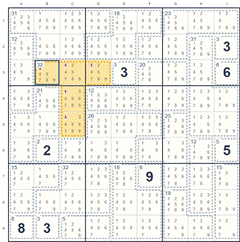
Cage combinations
Use the cage total and the no-repeat rule to work out which sets of digits can fit.
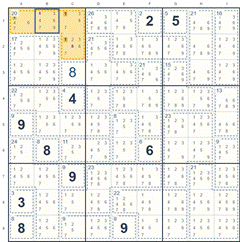
Cage combination positions
Check whether a cage combination can actually be assigned to its individual cells.
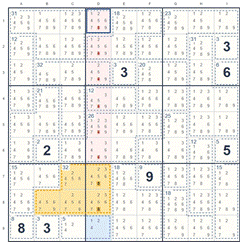
Cage locked digits
A digit required by a cage is confined to one row, column or box. Remove it from that house outside the cage.
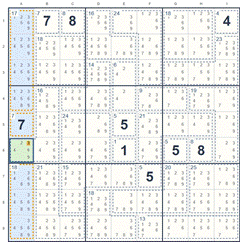
45 rule: innies and outies
Every row, column and box totals 45. Compare that sum with complete cage totals to find missing digits or smaller sums.
Columns are labeled A-I from left to right and rows 1-9 from top to bottom. A house is a row, column or 3 × 3 box. Cage outlines and thick box borders describe different groups of cells.