











Cage combinations
Use the cage total and the no-repeat rule to work out which sets of digits can fit.
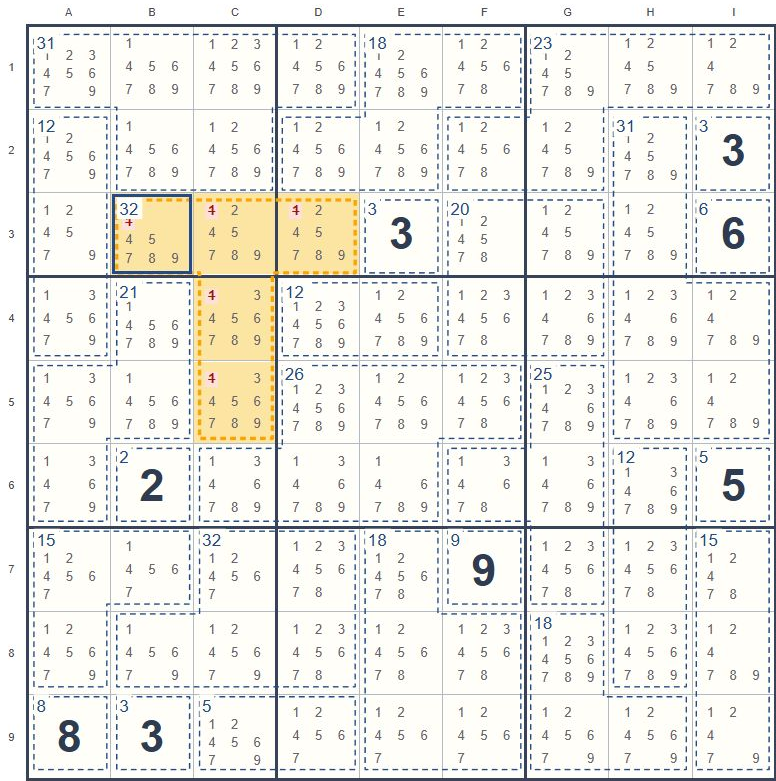
The cage at B3, C3, D3, C4 and C5 totals 32 and its digits cannot repeat. The highlighted candidates occur in no combination compatible with that total, its filled digits and its remaining candidates. Remove candidate 1 from B3, C3, D3, C4 and C5.
What to look for
Start with small cages and unusually low or high totals. Account for filled digits, then list the distinct-digit combinations that reach the remaining sum in the right number of cells.
Why it works
Every completed cage must use one of the combinations that reaches its total without repeating a digit. A candidate that occurs in none of those combinations can be removed. Knowing the set of digits does not necessarily tell you their order.
Try it step by step
- Subtract any filled digits from the total and count the empty cells.
- List combinations with that many different digits and the remaining sum. Exclude digits already used in the cage.
- Collect the digits that occur in at least one remaining combination. Remove every other candidate from the cage's empty cells.
A useful starting point
Two-cell totals 3, 4, 16 and 17 each have only one distinct-digit combination: {1, 2}, {1, 3}, {7, 9} and {8, 9}. A two-cell cage totaling 9 allows {1, 8}, {2, 7}, {3, 6} and {4, 5}; neither cell can contain 9.
Try it on a real puzzle
Start with the highlighted step, then keep solving. Use "Apply hint" to make the suggested change, or enter your own digits and candidate notes. Use "Undo" to reverse your last change.
| A | B | C | D | E | F | G | H | I | |
|---|---|---|---|---|---|---|---|---|---|
| 1 | |||||||||
| 2 | |||||||||
| 3 | |||||||||
| 4 | |||||||||
| 5 | |||||||||
| 6 | |||||||||
| 7 | |||||||||
| 8 | |||||||||
| 9 |
Use the arrow keys to move, 1-9 to enter a digit and Backspace or Delete to clear a cell. To add or remove a candidate, press C and then 1-9.
Source puzzle number: 55194K · Play this puzzle from the start
A simple example
A two-cell cage totaling 4 must contain 1 and 3. The alternative 2 + 2 is forbidden because cage digits cannot repeat. Neither cell can keep any other candidate, but the total alone does not decide which cell is 1.
A house is a row, column or 3 × 3 box. Digits cannot repeat in a house or a cage. A cage total applies only to the cells inside its outline. Columns are labeled A-I from left to right and rows 1-9 from top to bottom. C1 means column C, row 1. Boxes are numbered 1-9 from left to right and top to bottom. Braces such as {1, 2} show a cell's candidates, not confirmed digits.