











Cage combination positions
Check whether a cage combination can actually be assigned to its individual cells.
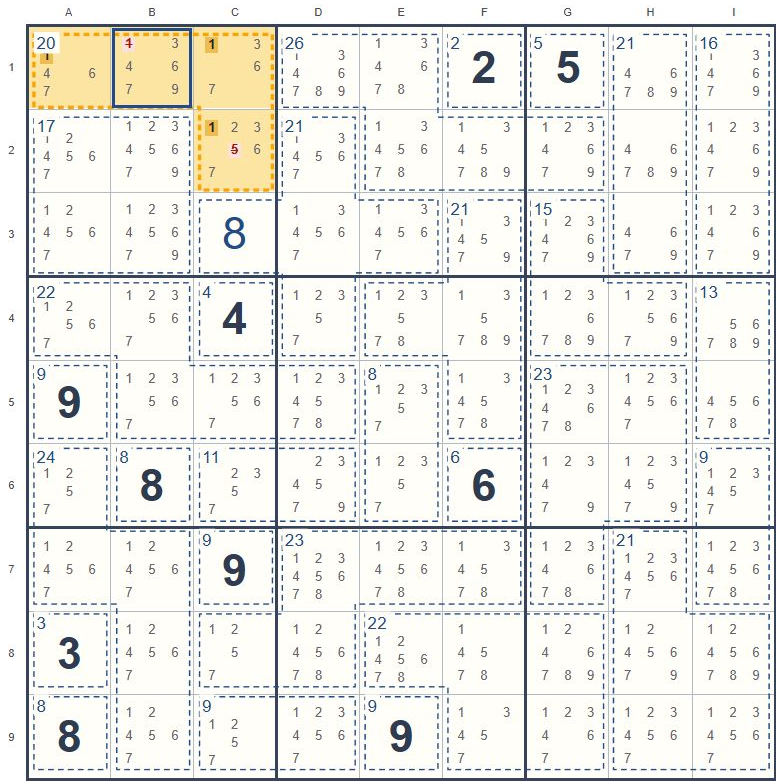
The cage at A1, B1, C1 and C2 must total 20 without repeating a digit. Check its valid combinations against each cell's candidates. None of the valid arrangements can put the highlighted candidates in their cells. Remove candidate 1 from B1 and candidate 5 from C2.
What to look for
Use this after listing the possible cage combinations. Compare each digit with each empty cell's candidates, paying particular attention to cells with only a few options.
Why it works
A combination is useful only if all its digits can occupy different cells at the same time. A digit appearing somewhere in the cage is not enough: placing it must leave valid positions for all the other digits. Remove a candidate if no valid arrangement uses it in that cell.
Try it step by step
- List the cage's possible combinations after accounting for filled digits.
- For each combination, try assigning its digits to different cells using only the candidates in those cells.
- Remove candidates that appear in no valid arrangement, keeping every arrangement that still fits.
Check the whole arrangement
Do not accept a combination merely because each of its digits appears somewhere among the notes. Two required digits might both be restricted to the same single cell. Every digit needs its own position in one complete arrangement.
Try it on a real puzzle
Start with the highlighted step, then keep solving. Use "Apply hint" to make the suggested change, or enter your own digits and candidate notes. Use "Undo" to reverse your last change.
| A | B | C | D | E | F | G | H | I | |
|---|---|---|---|---|---|---|---|---|---|
| 1 | |||||||||
| 2 | |||||||||
| 3 | |||||||||
| 4 | |||||||||
| 5 | |||||||||
| 6 | |||||||||
| 7 | |||||||||
| 8 | |||||||||
| 9 |
Use the arrow keys to move, 1-9 to enter a digit and Backspace or Delete to clear a cell. To add or remove a candidate, press C and then 1-9.
Source puzzle number: 13229K · Play this puzzle from the start
A simple example
A two-cell cage totals 10. A1 has {1, 2} and B1 has {3, 8, 9}. The valid arrangements are A1 = 1 with B1 = 9, or A1 = 2 with B1 = 8. Remove 3 from B1: it would require a 7 in A1, where 7 is unavailable.
A house is a row, column or 3 × 3 box. Digits cannot repeat in a house or a cage. A cage total applies only to the cells inside its outline. Columns are labeled A-I from left to right and rows 1-9 from top to bottom. C1 means column C, row 1. Boxes are numbered 1-9 from left to right and top to bottom. Braces such as {1, 2} show a cell's candidates, not confirmed digits.