











45 rule: innies and outies
Every row, column and box totals 45. Compare that sum with complete cage totals to find missing digits or smaller sums.
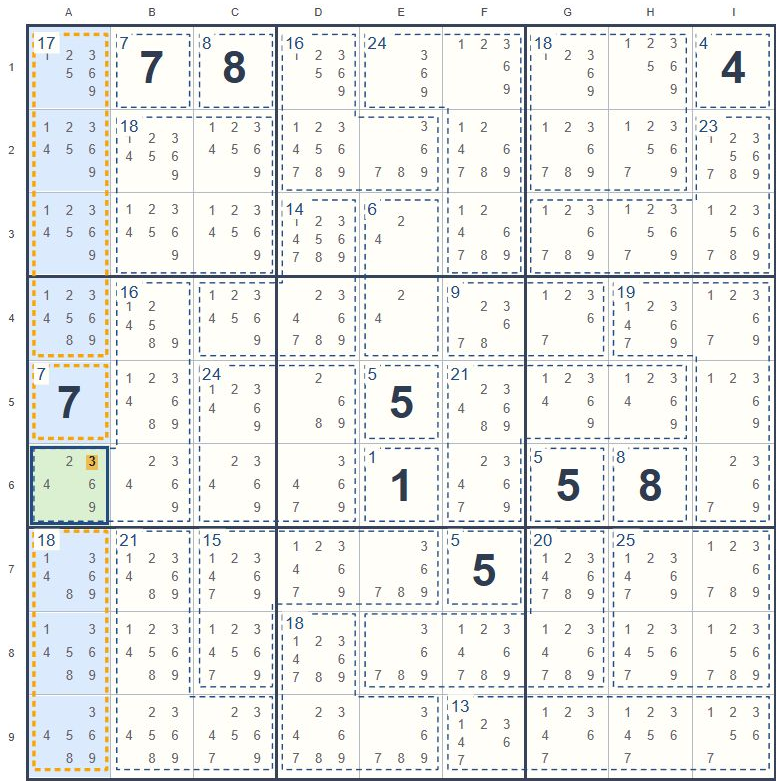
Every row, column and box totals 45. Combining column A with the whole cage totals shows that the highlighted cells A6 total 3. Subtract the filled digits in these cells. The remaining cell A6 must contain 3.
What to look for
Choose a row, column or box and examine the cages touching it. Look for whole cages that leave only a small gap inside the house, or cages covering the house with only a few cells extending outside.
Why it works
The digits 1-9 add up to 45. Cage totals give the sum of their complete, non-overlapping cell groups. Comparing the same cells in these two ways reveals the total of any uncovered cells inside the house or extra cells outside it.
Try it step by step
- Choose a house and mark exactly which complete cages you are adding.
- Compare their combined total with 45, accounting for every cell inside and outside the house exactly once.
- Subtract filled digits from the remaining group. Fill a single empty cell, or use the smaller sum to eliminate impossible candidates.
Innies: the cells left inside
Add only cages lying completely inside the chosen house. Subtract their total from 45. The result is the sum of the house's uncovered cells, called innies. If those cells already include filled digits, subtract them before working out the empty cells.
Outies: the cells extending outside
Add every cage that touches the chosen house, counting each cage once. Together they cover all nine cells of the house and may extend beyond it. Subtract 45 from their combined total to find the sum of those outside cells, called outies. One outside empty cell can be solved directly after subtracting any filled outside digits.
Several cells can share a useful sum
An innie group lies in one house, so its digits cannot repeat. An outie group is not automatically a cage or a house: outside cells can repeat a digit unless their actual rows, columns, boxes or cages forbid it. Keep those constraints separate when using the sum. The solver's multi-cell 45-rule eliminations use distinct innies; its outie hints solve a single remaining outside cell.
Try it on a real puzzle
Start with the highlighted step, then keep solving. Use "Apply hint" to make the suggested change, or enter your own digits and candidate notes. Use "Undo" to reverse your last change.
| A | B | C | D | E | F | G | H | I | |
|---|---|---|---|---|---|---|---|---|---|
| 1 | |||||||||
| 2 | |||||||||
| 3 | |||||||||
| 4 | |||||||||
| 5 | |||||||||
| 6 | |||||||||
| 7 | |||||||||
| 8 | |||||||||
| 9 |
Use the arrow keys to move, 1-9 to enter a digit and Backspace or Delete to clear a cell. To add or remove a candidate, press C and then 1-9.
Source puzzle number: 81819K · Play this puzzle from the start
A simple example
Whole cages entirely inside row 1 cover eight cells and total 39. The remaining cell must be 6 because 45 - 39 = 6. If cages covering a box total 50 and extend to just one cell outside it, that outside cell must be 5 because 50 - 45 = 5.
A house is a row, column or 3 × 3 box. Digits cannot repeat in a house or a cage. A cage total applies only to the cells inside its outline. Columns are labeled A-I from left to right and rows 1-9 from top to bottom. C1 means column C, row 1. Boxes are numbered 1-9 from left to right and top to bottom. Braces such as {1, 2} show a cell's candidates, not confirmed digits.